8. Preparation
Can you ever really be prepared for the arrival of your first child?
I think back to those final days before he arrived, and what I wrote in my notebook at the time.
The board’s column for kitchen tasks stands empty as granola and roast garlic are ticked. ‘Be Ready’ gets written in its place…
The kitchen is as organised and clean as it has ever been. Restlessness has caused me to finally replace the set of glasses that just don’t respond to the dishwasher, and to put up a final few pictures which were resting against the wall. I clean the cutlery drawers, and sharpen the knives – and not just a regular sharpen but an overdue thinning of the blade of the nakiri. Is this controlling the controllable? Enjoying the finally finished kitchen before the invasion of sterilisers, playmate, Moses baskets and (eventually) high chairs?
As much as anything it’s an energy outlet. The big question: are we prepared?
Prepared for our lives to change. For priorities to radically change. For time to disappear. For food obsession to be besieged by exhaustion and other things. For the (potential) disappointment of a fussy child or the challenge of a child with allergies.
But all of those big questions of ‘are we prepared?’ get subsumed into the more day-to-day. Is the birth bag ready? Can the designated hospital snacks be produced without a dash out of the house for bread and bananas? Is the freezer full of things that require no prep and easy components? Do we have a store cupboard to survive weeks without visiting specialist shops? Do we have the building blocks – roast garlic, for example – to make delicious cooking quick and easy?
This past week the milestone of our boy turning eight months coincided with another mini-milestone when I ate the last of our prep dishes from the freezer – green beans stir-fried with minced pork and Sichuan pepper.
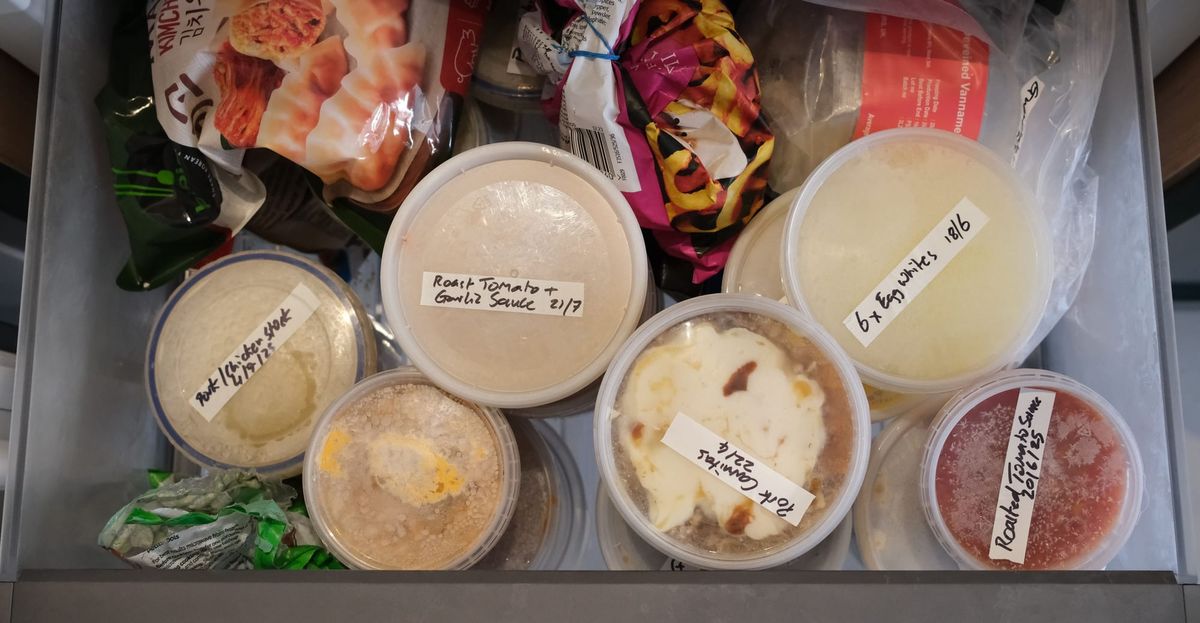
The counsel of close friends just ahead of us in the parenting journey had been to fill the freezer with food. We swapped out our endless takeaway boxes for some glass containers that can go straight from freezer to microwave, and cooked away. There were three categories of what we made: complete meals, like a curry with rice; dishes which would need a minimal level of cooking to add a carb – a pasta sauce, the green beans; and cooking components to make something easily – two big tubs of satay sauce to go over a chicken or a roast hispi cabbage for example.
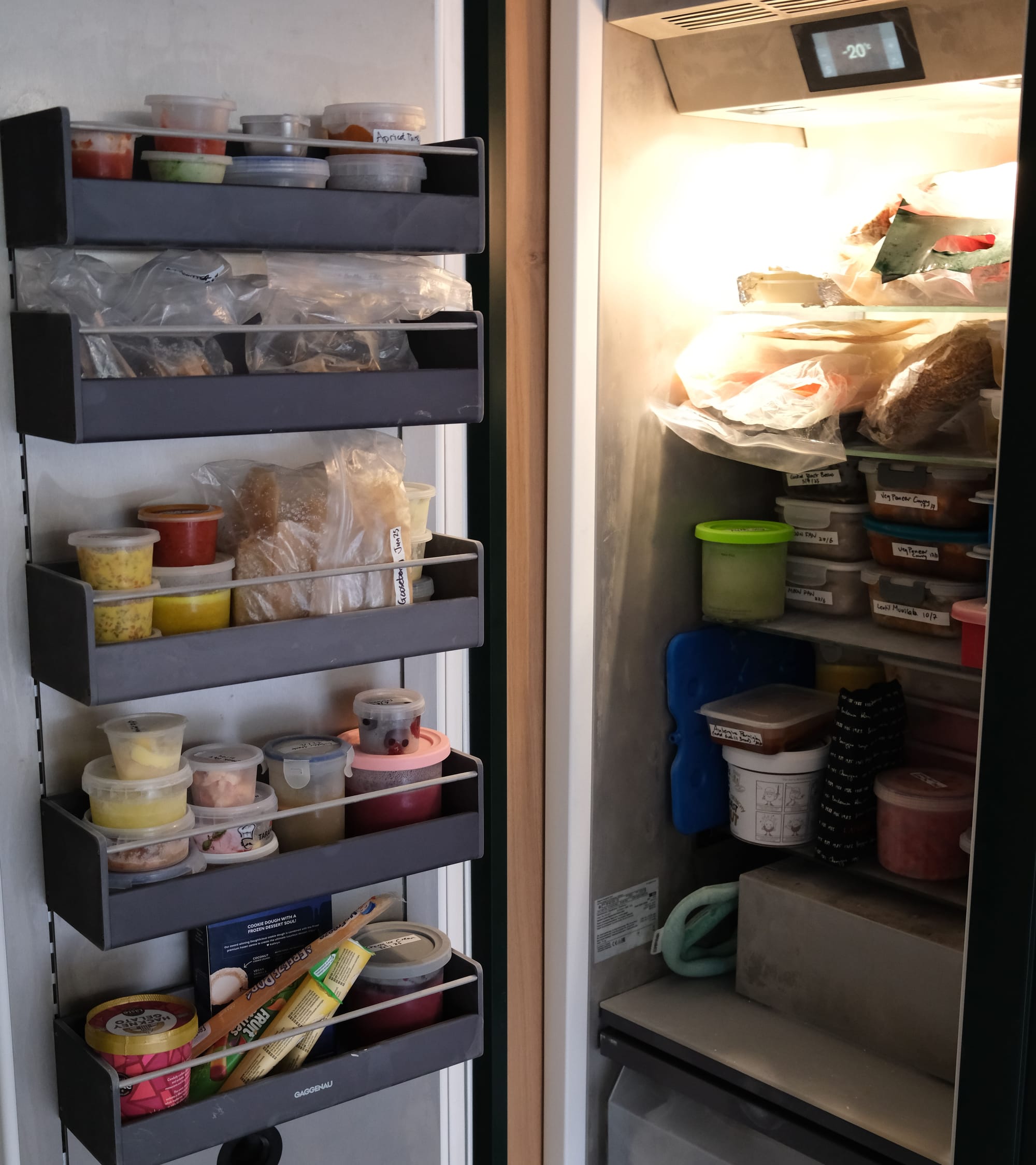
We did use some of it in the early days, but not much due to the generosity of family and friends who were bringing lots of food to keep us going through those first weeks. I wonder if the main benefit of it was the making of it and feeling – in this small but significant way, at least – prepared for the life change about to happen.
As well as preparing for life when the baby was home, we also spent many weeks preparing for the birth itself, with a big focus on the food and drinks to get my partner through labour.
The menu included items which were easy to have on standby… chocolate buttons, Hula Hoops, Tangastics, coconut water, Lucozade Sport for my partner and bottles of Japanese cold coffee for me. The challenge came in being prepared for the fresh items: hummus and cheese sandwiches, and bananas. It’s really misleading to focus on a ‘due date’ – in reality there is a five-week window where the baby can arrive neither prematurely nor overdue. The due date you have is just three weeks into that period. We’d concluded that in spite of early labour usually taking hours or days, it would not be a good idea for me to leave the house during that time. So I had to be ready to make the sandwiches and pack the bananas at any point.
This meant we went through a bread heavy few weeks. Whilst a loaf can be good for toast for a week, the window for a good sandwich is a couple of days, stretching into three at most if you wrap the bread well. We pass the time getting more creative with toppings. Fresh cheese drizzled with honey and chilli crisp, served alongside some salad or vegetable dish, becomes a hot favourite for several days.
Labour starts on Friday evening. It proceeds in fits and starts and a most irregular pattern of contractions through day and night. On Sunday morning the weirdly long contractions mean we are advised to come into the hospital for a check. I make the sandwiches – it’s day four of a Gail’s San Francisco Sourdough but I have minutes to assemble them while we wait for the Uber. I have bananas, but it's a heatwave and the fruit flies are in full force so I’ve been keeping them in the fridge and the skin is completely black.
When we get to the hospital my partner is taken away for monitoring, and it’s the only time I’m not allowed to go with her. Apart from the diabetes test, I’ve been at every appointment and every scan until now. It feels really surreal to be apart at this moment. I eat my sandwich alone in a waiting area of expectant dads sitting in worried silence. The bread is really dry – the way labour is panning out has made a mockery of the sandwich cycle. I keep the other for my partner, but she never gets to eat it. Monitoring turns into admission to the labour ward and we’re back together, but she’s nil-by-mouth in case of the need for a C-Section. The chocolate buttons go untouched.
The refreshment section is just one of many parts of the birth plan that gets shredded by the reality of how it’s panning out. I eat my partner’s sandwich in the middle of the afternoon in a moment of calm where we attempt to play rummy. I’ve finished the sandwich but we haven’t finished the game when things step up a gear with alarms sounding, decisions to be made and new plans put in place. Just before 9pm he arrives in theatre with an assisted delivery, geographically only a floor away from the Birth Centre we had opted for, but in every other dimension a world’s distance from what we had planned.
Having plans shredded by reality is a good preparation for parenting. My conclusion from our pre-birth planning is that it’s the planning rather than the plan that matters. Taking the time to think through what’s going to happen, the choices to be made, and the resources needed – all of which we’d talked about through the planning process – was a massive help to us when we had to ditch the actual plan. Having the freezer full of food helped us to feel ready, and took stress away from the first weeks back home, even if we didn't eat all of it. If a window opened up to buy and cook some food, I happily jumped through it. But not spending most of the time after breakfast thinking about the what and how of dinner (which is most days for me) removed things from my head to be in those early moments of figuring out how to parent.
The best kind of preparation for feeding the household has, I think, always involved having good building blocks for creating something delicious: stocks in the freezer or in dried form, roast garlic in oil in the fridge, wild garlic pesto and butter in the freezer, flavour bombs like roasted tomatoes or a chilli sauce. The things which help you get to something great in moments rather than finished dishes boxed and frozen. As we continue to wean our boy, the freezer now holds little portions of cooked rice, mushed up beans, and smashed lentils, ready to be the base of a meal, pimped up with whatever sauce, vegetable or protein we’re cooking fresh.
Are we ever prepared? Never for all the things that could happen, but always prepared to find a way through.
Roast Garlic
This is a staple in the kitchen – not only a quick way to get garlic into a dish, but often the best way, and a really easy way to turn mayonnaise into aioli and butter into garlic butter
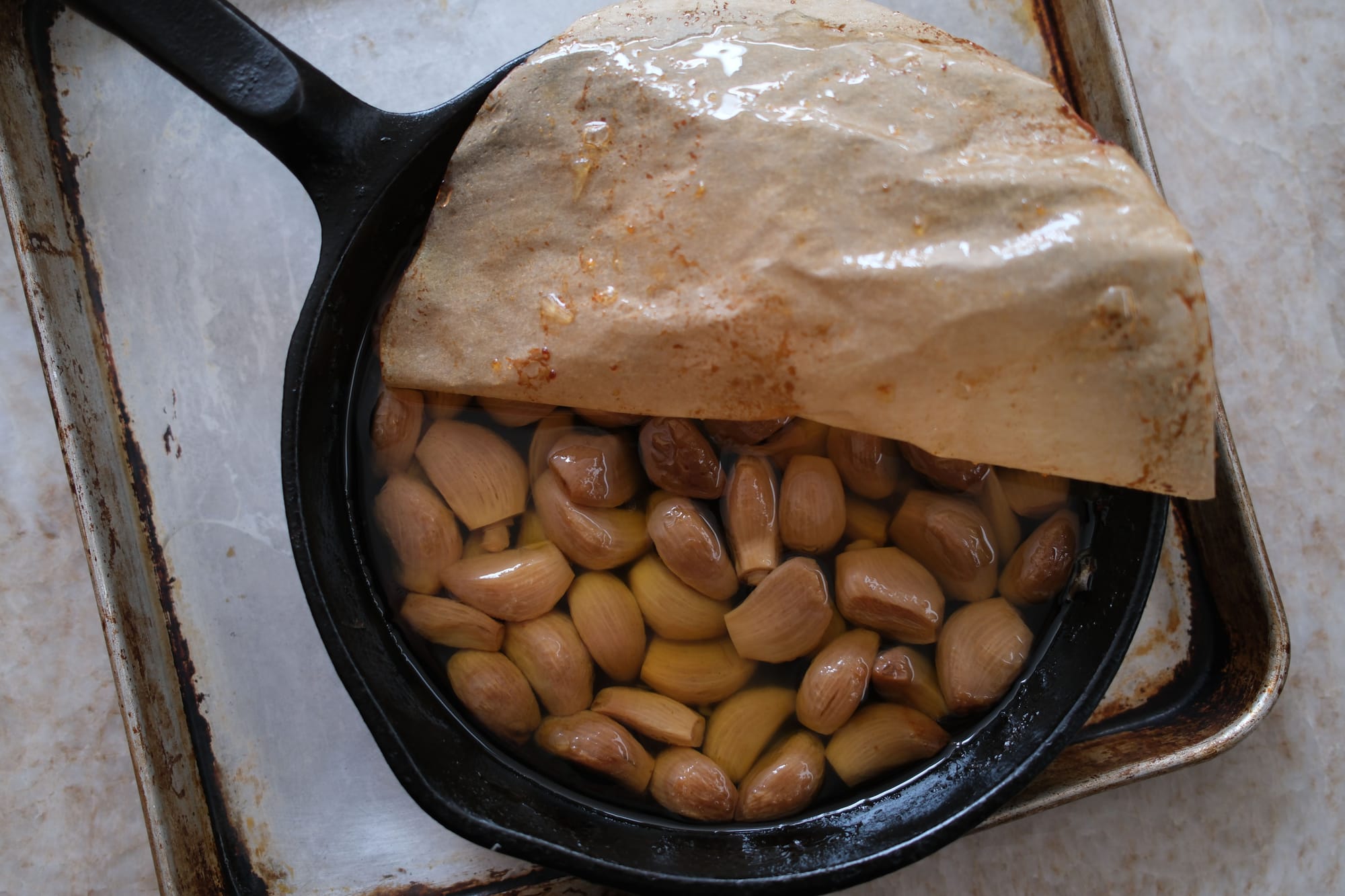
For one jar's worth – take 5-6 whole heads of garlic, looking for ones which are firm. Separate out the cloves and peel them, checking carefully for any damage or marks. You can cut out any black or brown bits, but do chuck the clove if it is very brown or soft in any way.
Arrange in a shallow baking dish or cast iron pan and cover with olive oil. Add some parchment on top, and cover with foil.
Bake at 170º for 45 minutes. Allow to cool and transfer to a jar, topping off with the oil. Always ensure that the cloves are fully submerged in the oil, and then store it in the fridge. You may need to bring it out and let it come up to room temperature to easily fish out the individual cloves, but you can dig them out with a teaspoon if the oil has solidified. If you do this, make sure to cover the cloves again with oil before storing it. It should be fine for a month.