15. When food became a measure of mental health
Food sustains this house. In a literal sense, of course, but it’s also the drumbeat of our life. The tasks of shopping, cooking and eating give the day structure, and anticipation of something great for dinner often lifts spirits throughout the day.
Except, for a period of time, it didn’t.
During those first, difficult months of parenthood, as my partner experienced severe post-natal depression and anxiety, her interest in food – normally so strong and passionate – disappeared. As we navigated through the most difficult weeks, the first glimmers of interest in what we were going to eat became a measure of progress in her return to her usual self. Small flashes that I would build off by trying to meet anticipation with the satisfaction of a well-cooked meal, building belief that the pleasure centres of the brain – so ruthlessly and brutally shut down by the depression – were starting to function once again. The descent into depression was swift, but mercifully the climb back out was also quite fast, measured in weeks not months, and re-connecting to the pleasure of eating was certainly a sign, and maybe in some part a reason for that.
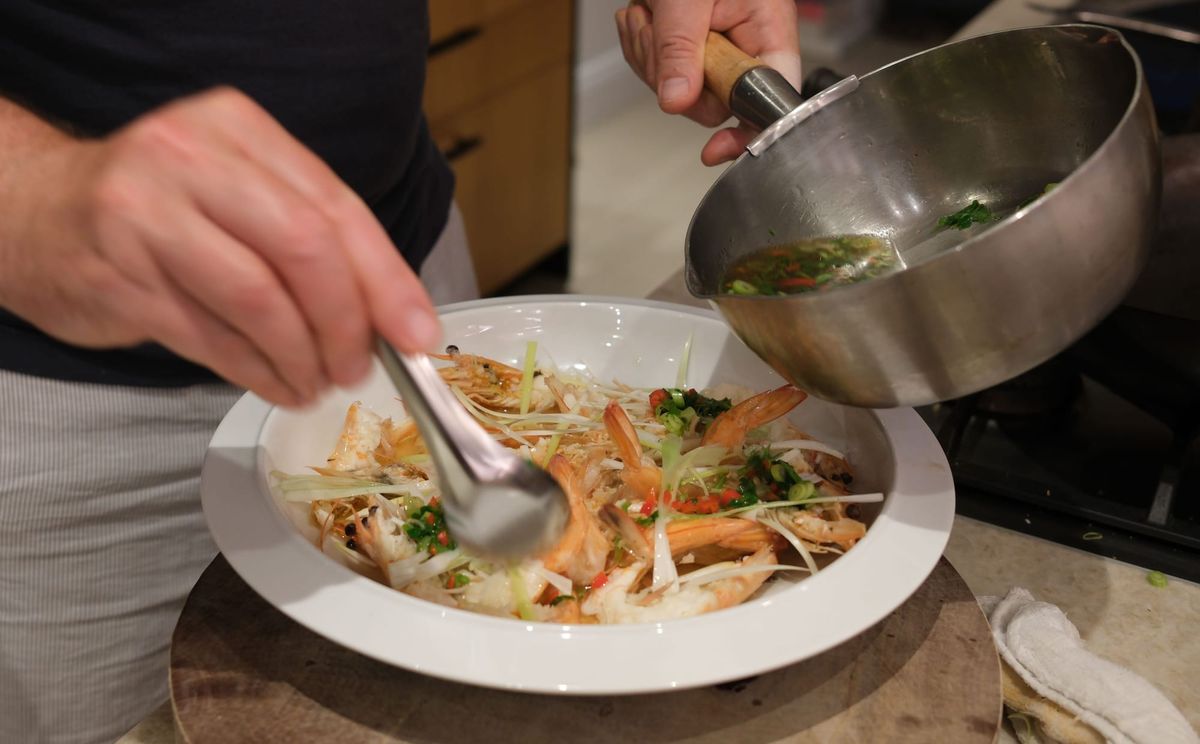
A few days before birth, and so several days after the official due date, my partner was having a difficult day. It was hot. We’d had a stressful few days of additional scans, and while they were all OK, she was low on energy, feeling frustrated, and avoiding the inbounds of ‘any news?’. She wandered into the kitchen where I was watching episodes of Andrew Wong’s Secrets of the Chinese Kitchen. It was the episode on Cantonese steamed seafood, and then one on spring rolls. The energy lifted, the suggestions started and soon it was settled that we would make the next few days fun through food. This is how we usually live – while we do other things too, it’s food which is most often the thing that excites us. We ended up making crab and black pepper spring rolls, mushroom wontons, and the steamed prawns split, dressed with garlic oil before cooking, then onto a serving dish where they were doused with stock, soy, chilli and coriander. The final touch: topped with sliced spring onion which was drenched with hot oil. It was a delicious and memorable meal, the last big cook before the baby arrived a few days later.
The next big moment when food lifted our mood came eleven days after the birth. Following a postpartum haemorrhage we were back in hospital. The bleed happened at home at 6am, we were in the hospital at 7am, and after checks and being admitted, she was ‘nil-by-mouth’ until a procedure under general anaesthetic. By late afternoon she was coming round, back with me and our son. That it was fixed quickly felt, at the time, like a relief. We’d raced to the hospital without many things, under-prepared for spending the night. A dear friend offered to bring supplies. “Do you think we could get pizza?”, my partner asked. Our friend came up with the goods. Outside food is frowned upon in the high dependency unit, so I hide it under a pack of Pampers and walk it in. Doughy and thick base, sticky sweet sauce. Too much cheese. Pepperoni. Totally delicious and we laugh as we say it is probably the best pizza we’ve ever eaten.
What we didn’t realise was the physical and emotional toll this haemorrhage would cause, and how this recovery, with a difficult breast feeding journey, would soon lead to a rapid descent into severe postnatal depression and anxiety.
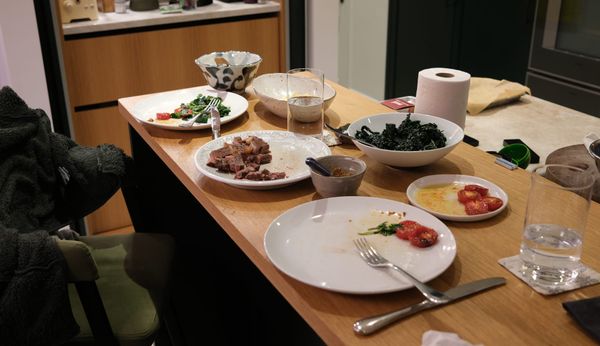
We live off food cooked and delivered by friends and family for the first few weeks, but as my partner gets physically weaker I start to cook more to try and boost recovery. I cook steak and spinach and keep all dairy out of the meal to maximise iron absorption. We cry through the meal as we acknowledge where we are but feel real hope that we can get through it quickly. I make a daily snack of chicken livers on toast. At this stage we’re coping. Food’s not a priority, but we do connect over little moments like what flavouring I’ve added to that day’s livers. But a week later we’re fully into crisis. Depression and anxiety invade quickly, brutally shutting down the brain’s ability to find and experience pleasure, and routing all signals to the part which deals with doubt and fear. Everything becomes a struggle. We talk and talk but words and facts and reasoning are no match for the forces which are remaking how she feels and operates. We don’t even think about getting through the day, we just think about getting to the next feed, nap or breast pumping.
With all capacity for pleasure seemingly cut off, interest in food plummets, finding joy in it seems like something that characterised a different person. But I try to keep up some cooking, mostly as an anchor for my sanity. As I’m doing lots of the childcare while my partner sleeps, I strap him into a sling and cook. I make some granola first to get used to moving around the kitchen with a baby strapped to me. We come through that unscathed so I stir fry aubergines in a Sichuanese sauce. I make one of our stalwarts – probably the dish we’ve cooked and eaten the most in our time together – of kale pasta with garlic, chilli and anchovy and it’s unbelievably delicious. Most of our meals are eaten with me holding him, so I focus on food we can eat with one hand: black beans topped with corn, avocado, salsa verde, garlic sour cream and pickled red onions, a curry of aubergine, mushrooms and spinach.
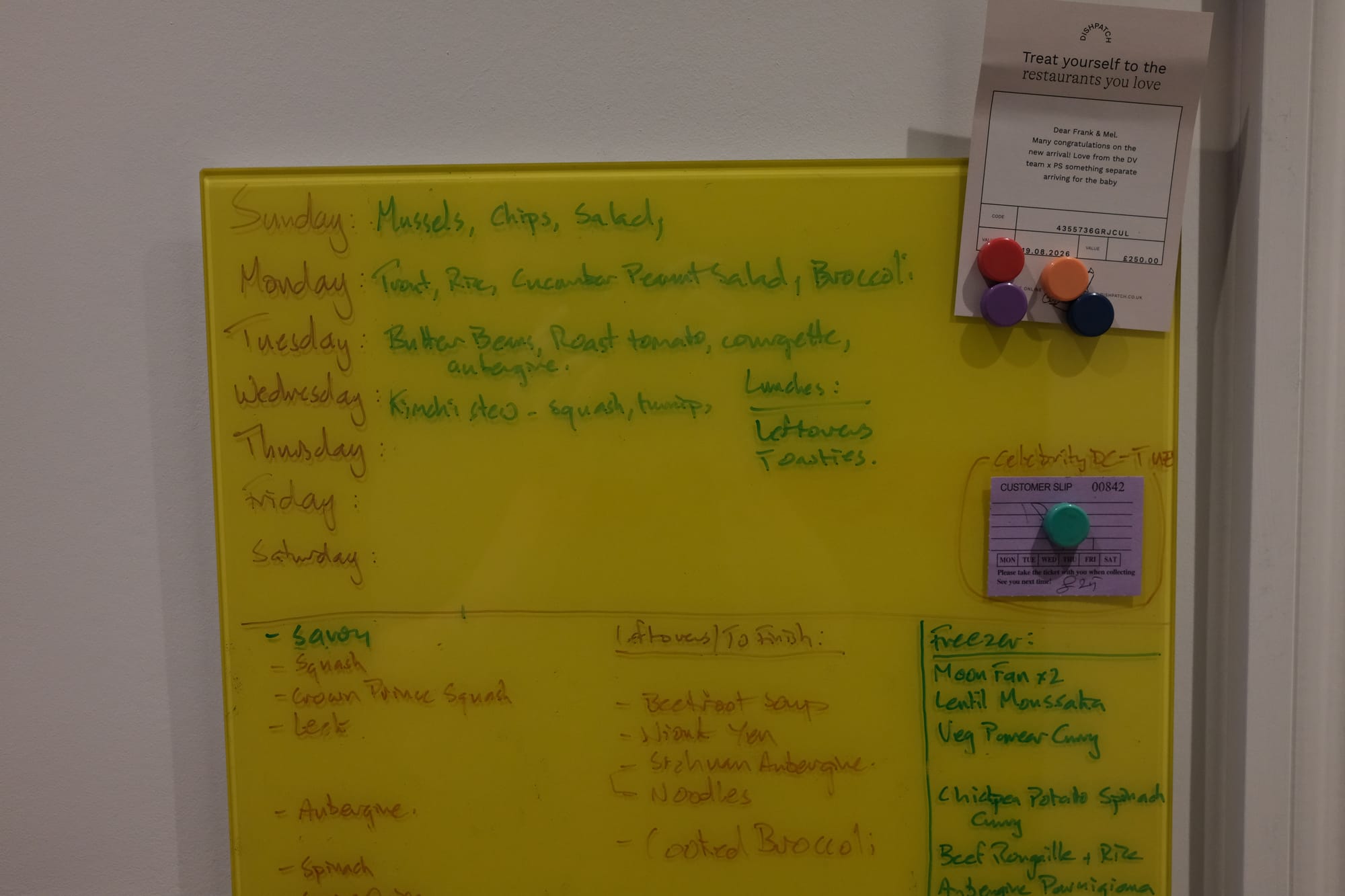
But as my relationship with food starts creeping back to its pre-baby levels, my partner’s is fading. We’re soon in a never-ending loop of mental health assessments. “How’s your appetite? Are you eating?” is a constant question. She is eating, but only because we are making her. Appetite has gone. It’s not just food. Her interest in anything is pretty small – and while throughout this she continues to care for our son brilliantly, the anxious depressed mind can’t see or believe this and the negative spiral accelerates. I write in my notebook “The woman who would ask early in the day ‘what’s for dinner?’, who would run the menu board, who would rarely be without a craving… that woman has seemingly gone”.
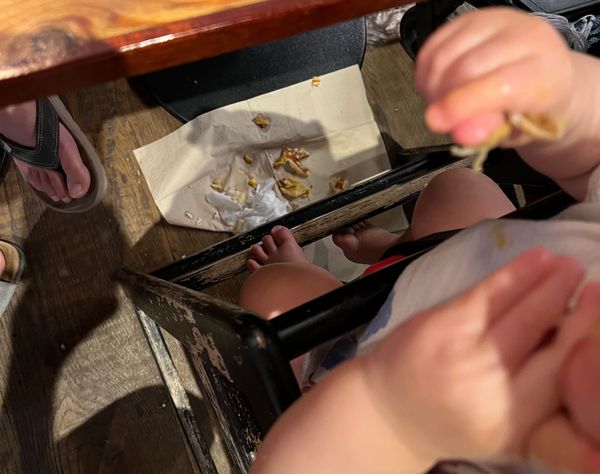
We crawl through the worst two weeks, and with things slightly calmer, I try desperately to connect her to things which will spark some sense of joy. Before birth she had got excited about some of the baby clothes we had. We’ve been dressing him in things handed on from family, and we’re short a few items so I suggest we walk to a second-hand baby clothes shop to pick some things out. It’s a beautiful sunny day. We buy some cute things. We find a spot to sit in the sun. A few people around us are eating pizza. Her craving for a slice is usually a constant… but I’m the one who suggests we get one, and it triggers a twinge of appetite. We eat an excellent crispy slice of pepperoni pizza sitting in the sun, our cute son attracting the attention of strangers. We head home. She’s exhausted and sleeps. I look after the boy and make chickpeas with spinach, a favourite we first enjoyed together in Seville and which I’ve cooked many times since. That night we eat together and she comments on how good it is. My heart leaps at this small sign of recovery.
Progress is slow and certainly not linear. We have stretches of good days and then crash back into the lows. This depression – like many – responds best to the combination of psychological (talking) and psychiatric (medication) treatment. I try and mimic this with conversation and cooking – my version of medication to provide physical and mental comfort. I have my best week of cooking since the birth. Mussels and chips. Trout glazed with miso and served over rice, with a knockout spicy peanut and cucumber salad. Kimchi-jigae – a braise of vegetables, noodles and kimchi cooked in a claypot. Butter beans with roasted tomatoes, aubergines and courgette – a last taste of summer made autumnal with a crust of melted cheddar. While still not thinking ahead and throwing out her cravings, she is now noticing the food she’s eating.
Flashes of appetite start to appear – she wants noodles and says she’s been thinking about duck so we play to the craving and order in from Singapore Garden. We devour it. It’s Thursday and I don’t have a meal planned. I survey the fridge and make some suggestions and she chooses cheesy polenta with garlicky greens on top. I pre-soak the polenta to try and reduce the time needed to cook – and constantly stir – it. The cooking gets interrupted halfway through to give him a bath and settle him, but I recover it and get it almost silky-smooth. She says it’s nice.
My joy in hearing her express preferences and offer judgements is for once not about my culinary ego. I’m clinging to this measure of how close we are to getting back to her real self, to finding the pleasure circuits in the brain starting to fire up again.
Our weeks are still peppered with dark periods, but more food thoughts are happening and being voiced. She asks what goes with lentils, and whether we’re in mushroom season yet. I can get some smoked duck for lentils, I say, and yes, the mushrooms are here. We’ve got a few bits to finish up, so shall we have a picky tea? I ask. Yes, as long as it includes garlic bread, she replies.
Figs look great at the fruit stall and I serve them topped with fresh cheese, honey and jalapeño. I get a request to get more. I roast mushrooms and make a sauce we have with pappardelle. It’s so delicious and we eat it from big bowls on the sofa, our boy asleep between us, watching a series on Netflix. “This is what I thought parenthood would be,” she smiles.
I render the skin of the smoked duck and fry shallots and then the duck breast meat before stirring all of that into lentils. The savoy cabbage that’s been sitting in the fridge for a few weeks since a mastitis scare now gets repurposed from physical treatment to food, shredded, tossed in duck fat and butter, and enjoyed.
We round out the week with a pulao studded with green beans and peas, beautifully spiced and slick with yoghurt and ghee. Alongside I serve one of her all time favourites: slices of aubergine dusted with kashmiri chilli and fried, then doused with garlic flavoured yogurt and a tarka of cumin and curry leaves sizzled in ghee. It’s delicious and she says so – “we never need to order takeaway again when you can make this”, she says.
Day by day, meal by meal, she comes back to us, discovering the joy in motherhood and rediscovering the pleasure in eating. We start to host again, manage a dinner out with just the two of us. We resume something resembling our usual evenings together at the kitchen counter – back to having two hands each, but focus now elsewhere as we watch the monitor showing our son sleeping upstairs.
Depression’s stranglehold on the brain’s ability to feel pleasure has been loosened and we take advantage by cooking, craving, eating, and laughing. I can’t say for sure whether the food helped, or whether it was just one of the clearest indicators of her mental state. Credit must largely go to the psychiatric and psychological help, the self-help, friends and family, and now a smiling, cute child. They all came together, and measured meal-by-meal, my partner returned.
Kale Pasta
Put a pan of water on to boil while you take the tough stems out of a bunch of kale and slice it into strips. When the water is boiling, blanch the kale for a few minutes and then drain. Add your pasta of choice to cook. Shells work quite well as the sauce clings to the insides and the cooking time is about perfect for making the sauce.
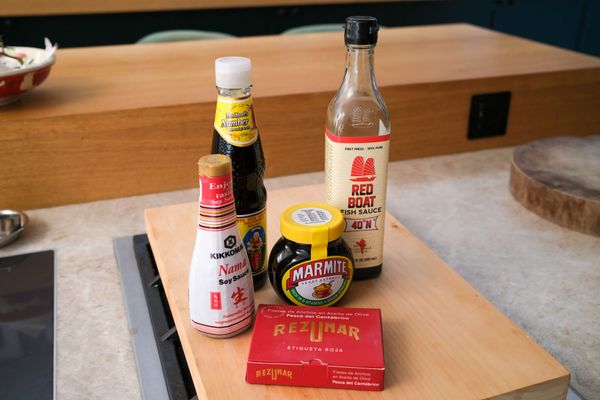
While the pasta is cooking, warm a generous amount of extra virgin olive oil. Add either chopped garlic or if you have it, roast garlic. Let it cook gently to infuse the oil. Add a couple of decent anchovies – up to four per person if you want. Let these dissolve into the oil, mashing them gently to help them along. Finally add chilli flakes, or your favourite chilli paste or oil.
Chop the blanched kale quite finely. You can even puree some of it to help the sauce coat the pasta, but finely chopped will do. Add it to the oil and toss to coat well. Grate a large amount of parmesan – a handful per person.
By now your pasta should be nearly cooked. Use a slotted spoon to transfer it to the kale and oil. Don't worry about taking a bit of water with it. Toss the pasta in the kale and oil, adding the parmesan and a few spoonfuls of the pasta cooking water. Keep tossing it, scraping the bottom, until everything is oozily coming together. Check the seasoning, add black pepper, and serve.