17. Illness
Just when you feel family life is in a good rhythm, everything jerks to a halt. He seems a bit off, you notice what could be the start of a rash on a finger, then his cheek. You all have a terrible night’s sleep and in the morning you face facts: he’s ill.
I’ll jump to the end and say nothing too serious and he’s mostly over it.
Back to the start of it: we realise that we don’t have a routine for this yet. Other than a slight temperature when he was a few weeks old (overstated by the kind of thermometer you point at their head, but still resulting in six hours’ observation in hospital), and a few colds, this is the first illness we’ve encountered. Across that first few days it was diagnosed as shingles (the chickenpox vaccine counting as the first exposure and this therefore being a reactivation of the virus), chickenpox (as the recency of the vaccine means he’s likely not immune so it wouldn’t be shingles yet), possible scarlet fever, or hand, foot and mouth. This poorly named condition is similar to chickenpox in that it comes from a virus, and results in spots all over the body which become sores. But it is very much the poor cousin of chickenpox. No benefit of lasting immunity, and it’s passable to those in close proximity (it was passed in mild form). What’s more it feels relatively recent as a widespread condition, with immunity gaps created by the Covid lockdowns leading to a surge when schools reopened, and new strains in the last two years causing a notable increase in outbreaks across many countries. Because of this, anyone who doesn’t have kids of primary school age or younger seemingly hasn’t really heard of it and asks you if you’ve been on a farm recently. It has nothing to do with foot and mouth, this being another reason why it could really do with a rebrand.
As the rash spreads, all plans with him are cancelled. We work out a schedule of what we’ll each do, dividing the load and sharing the damage to our own plans for the week. The first day has diagnosis purely from us, with frequent sprints through the checklists on the NHS ‘traffic lights’ app. Although he has a temperature, we’re comfortably in the ‘green’ – which means care for him at home. By day two the rash is all across his body. Although not scratching with his hands, he’s clearly really uncomfortable physically and so we visit the pharmacist to get an appropriate lotion. She thinks it's shingles and refers us to the GP. The picture gets complicated when the friends we were with a few days earlier tell us their kid has possible chickenpox and a skin infection requiring antibiotics. The GP thinks we have chickenpox, but then they review the photos with the team and possible scarlet fever comes into the mix and we're given antibiotics in case he gets worse in the night. He doesn’t and the diagnosis moves on to hand, foot and mouth as being most likely.
None of this was worrying, even at the time. Instead two emotions dominate, sometimes colliding. The first is the overwhelming sympathy and concern for your kid who is far from their usual self. Appetite crashes. Favourite foods are rejected. Energy is off. Clinginess is up. Sleep is disrupted. Despite his vocabulary having more or less doubled to approximately four words, and his understanding of other words accelerating fast, he is far from being able to understand what’s going on and he very obviously feels rotten most of the time and you really feel for him. There are long periods of crying which take us right back to a year ago when all the world was new and bewildering to him.
But the second emotion soon rumbles up too – the feelings of frustration and annoyance at the fun things we had planned getting binned. It’s precisely because it’s not that serious that the space for this opens up. At the moments where he’s really uncomfortable and suffering you feel nothing but love and wanting to comfort him. But when he’s just a bit grouchy and the task of hanging up the washing takes five times as long as it needs to as he refuses to be put down, you get annoyed. And yes, sometimes you get annoyed at him.
Mostly life continues in a middle ground – caring for him, being a bit bored, feeling like you’re in a kind of lockdown. It’s not serious enough to require both of us at all times so we alternate, and while I love my Saturday with dear friends down in Brighton, I can’t quite escape the feeling of guilt that my partner is picking up the slack so I can do this, even though I did the whole of the previous day while she was at work.
On the worst day, intentions about screen time are jettisoned, as watching nursery rhymes seems to be the only thing that calms him, and the distraction of them enables us to get some food in him after normal feeding fails. Prior to the illness, we often sang “Row, Row, Row Your Boat….” as the line “if you see a crocodile, don’t forget to scream” would see him respond with the cutest little cry, causing us to fall about laughing, and to encourage him to do it in front of all our friends and family. So it’s really on us that during the day of watching nursery rhymes, this is the one he fixates on. So much so that even without the screen it becomes his comfort blanket. First thing in the morning he’ll look at you and say “row row”. You sing a verse and he responds with “row row”. You sing another. This continues all day. To keep it interesting I try and make up new verses – “if you see a porcupine, don’t forget to whine” is my best, but I don’t think he appreciated it.
We have whole afternoons where he won’t be put down. Even though I’ve let go of any expectation of getting anything else done, and set the ambition at just surviving the next few hours, it gets frustrating as he fights sleep, works himself into a frenzy of exhaustion and fights the discomfort in his body by kicking, pushing and contorting himself against yours.
We get hit with some terrible nights where he wakes crying and inconsolable in the middle of the night, sometimes taking an hour or more to settle. Your day starts badly and doesn’t improve as you alternate between holding him, singing “row row”, and settling for things which mitigate the crying when you give up hope of stopping it. We reimpose screen time limits and while sometimes he sits quietly as you read him a book, at others he tries to pass you the iPad and when you say “no” he acts out his emotions in a way which truly merits that much overused word ‘performative’.
It doesn’t feel good to feel annoyed at your sick child. We encourage each other to be kind to ourselves by acknowledging that sometimes his behaviour is objectively annoying, and we are all very sleep deprived by this point.
By day three we feel we’ve hit the peak, as the first spots start scabbing over and no new ones appear. But there’s still several more days where he’s clingy, crying and hard to distract. Fortunately we’re blessed by glorious late summer weather, so taking him for a walk or to the park helps both him and us break the cabin fever.
When his appetite faltered, my partner made congee, channeling what gives her comfort when ill. It works for him as well and this becomes his main food for a few days. Inevitably he doesn’t poo, and we introduce smashed up white beans cooked in chicken stock to get some fibre into him. He starts to eat lots of mashed up squash. Soon he’s back on the banana porridge at breakfast, and eating more, but he must have sores in his mouth as he gets more sensitive to spicy food. Five days in and I make a soft scrambled egg with trout, squash and rice and I get my first round of applause since before he was ill. He grabs the bowl at the end and tries to lick it clean.
I take him out to Wordplay at the Royal Festival Hall. He’s much more subdued than usual and just sits cradled in my arms. We walk to the Tate Modern where he has a half hour period of being utterly inconsolable but recovers just in time to enjoy the immersion into the lights and shadows and colours of Julio Le Parc. I think I’ve done too much too soon, but on the way home we play a game which leads to him laughing out loud – the first time I’ve heard his laughter in over a week. It’s a beautiful sound.
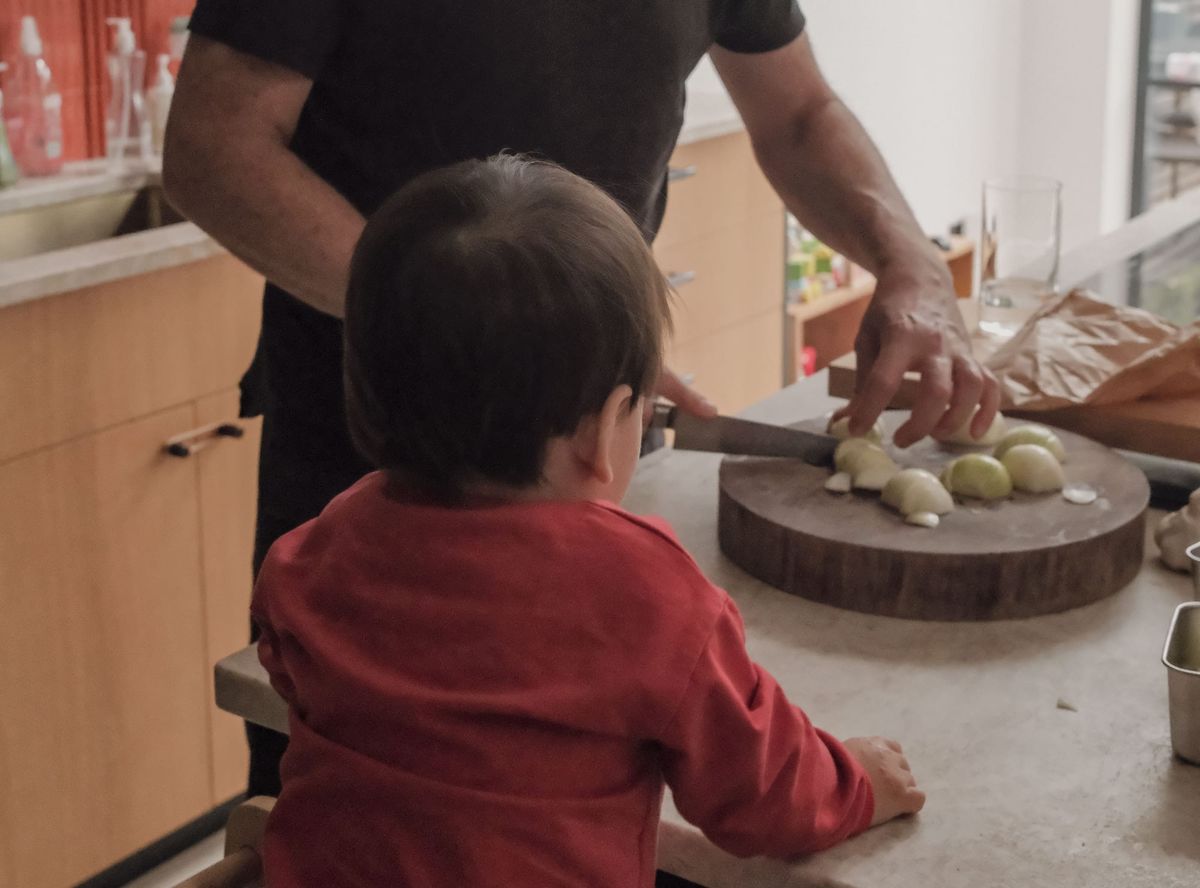
As he recovers, his clinginess recedes, and he resumes his attempts to walk. Progress from where he was before he got sick – being able to take a few unsupported steps – was halted for a week. But now he’s literally back on his feet and accelerating fast. He attempts longer and longer journeys without support, and then requests a single finger to hold on to when he want to go faster. He’s often giddy with excitement at this new skill and what it opens up. When he’s not walking he’s standing on his helper tower, watching the cooking and throwing every type of bowl and implement to see what makes the loudest sound. After a week spent mostly in bed or on the sofa, we're fully back in the kitchen, and with its multiple walking possibilities and the view from the helper tower it cements its place as the centre of family life.
The illness is over and rather than revert to how things were before, we find ourselves in a new and fun world. Frustration gets forgotten as we begin life with a proper toddler.