6. How I got comfortable switching to formula feeding
Our feeding journey over the first six months of our son’s life was completely different to what we had expected and planned for. Each step felt like an escalating challenge, and how we navigated them really shaped us as parents. For all the intentions of co-parenting, there are at least two important areas where biological reality puts the mother in the central position, with the demands on her body meaning she gets to make the call. Labour is one, and feeding the other. What we didn’t expect was how post-birth complications leading to post-natal depression and severe anxiety would force us to work so closely together to make decisions about feeding.
How to feed your baby is an emotional topic, with strong advocacy for both breast feeding and formula feeding. I’ll say right up front that we had some fabulous help in our feeding journey – friends, neighbours and some of the professionals we encountered were supportive, often beyond what we could have expected. However this positive support was often drowned out by opinions which were strongly argued, ‘facts’ which didn’t always stand up, advice which wasn’t centred on our own unique circumstances, and in one case downright cruelty. “They say breast feeding is not for cissies” we were told whilst my partner was in tears about how hard it was.
It took us a few weeks – long, difficult weeks where we were descending into the abyss of depression – to get through this to what worked for us, and this post shares some of our experience in the spirit of helping others who may find themselves in a similar place. I can’t emphasise enough that this is not advocating one path over another. Our choices were deeply personal and specific to our situation. In making them, the experience of others who’d had similar challenges helped us and I hope this may help someone else.
Pre-birth, my partner intended to breastfeed. This was always a choice which would be led by her, but of course I was happy with it. I’m a natural food guy who cooks most things from scratch. I can’t say I never touch heavily processed food, but it’s a very small part of what I eat. Honestly, if she had decided not to try breastfeeding I would have accepted it but doubt I would have been entirely comfortable with it.
In hindsight we were really unprepared for the possibility that breastfeeding might be anything other than intuitive and easy. I’d devoured a ‘week-by-week’ book to get prepared for the early days. The section on breastfeeding was short, and the part on latching was a boxed section on one page with four bullet points. Its brevity – alongside pages and pages on the topic of sleeping, for example – gave a false sense that it would be natural and instinctive. Antenatal classes with NCT were really good on labour and the early days of looking after a baby, but the dedicated evening on breastfeeding hinted at possible issues without giving us anything like a full understanding that breastfeeding can be incredibly hard.
We were as prepared as possible for labour, we had a freezer full of food for us, a pram and a crib. But our discussions on feeding were limited to divvying up responsibilities: mother will feed and I will do everything else – nappies, laundry, feeding us, getting him down to sleep and up to feed. We’re clear in our roles and think we’re set.
The first challenge was that milk didn’t arrive immediately after birth. After an anxiety-inducing labour with surges of adrenaline that left my partner shaking for hours, and a significant blood loss that led to transfusions, family life started with physical exhaustion and not much in the way of colostrum.
Although babies are said to be born with all they need for several days, it’s mid-August, the wards are full and not air-conditioned, and on day two he shows some signs of not having enough fluid, so in consultation with the midwives we decide to give him some formula. We hadn’t brought any, and as the hospital has a ‘breastfeeding first’ stance, it’s not readily available. As they agreed there was a dehydration risk, they do produce some, but the vibe is very much like they are passing us something illicit. I felt no hesitation in doing it – he wasn’t in any way in a serious condition, but he’s been alive for only 48 hours and we both felt he was a getting a bit less alert during a really hot afternoon and getting fluids into him felt important.
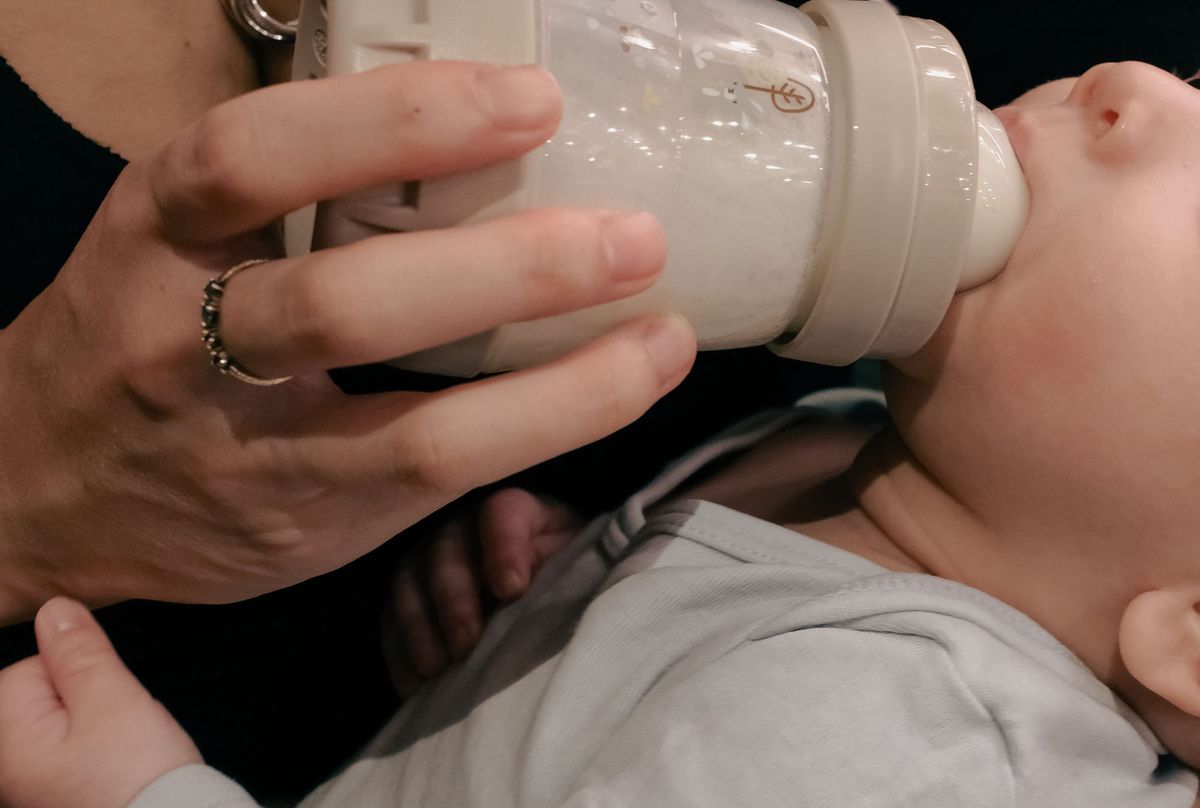
He feeds well, the next day we go home, and I have to quickly work out what we need for this unexpected way of feeding, hurriedly ordering bottles, cleaning brushes and sterilising bags, and working out our new operating processes. Before they’ve all arrived, on his fifth day alive, the milk comes in. And this is the next challenge because it comes in hard. We go from neither of us really knowing what a breast pump is to realising we need one urgently in the space of a couple of hours. A call out on the street WhatsApp group is answered and a neighbour comes to the rescue with not only the pump but a huge amount of practical advice and compassion. Although it’s a challenge, there’s enough milk for us to switch immediately to exclusive breast milk, a combination of direct and expressed. It's chaotic and hard to figure it all out quickly, often extremely uncomfortable for my partner, but seems to be working for him. It’s a bonus for me that I can feed him breast milk via bottle, even if that doesn’t take any burden off my partner who quickly becomes locked into a pumping and feeding schedule that feels non-stop. Latching for him is much more complicated than four bullet points implied.
This all gets harder when – just a week later – a significant postpartum haemorrhage sees us back in hospital. While we’re out the next day, relieved, a little shell-shocked and happy to be home, we fail to appreciate the sizeable impact it’s about to have on my partner’s physical and mental health. We try to pick up where we were, combining breastfeeding with expressed breast milk. Pumping, storing, sterilising, feeding – bottle and breast – feels like all we do, and none of it feels easy. Is he feeding enough? Is the feeding and pumping schedule in a place to keep the milk flowing but sending the right signals to the body to moderate milk production? The body’s amazing and it will settle down and regulate itself, we’re told…. But it’s taking its damned time. Physical exhaustion and the lingering anxiety of having lost a litre of blood all over the kitchen floor makes everything harder. The neat division of tasks we thought would work is kind of a mess as we just do what we need to do to get through each day, and increasingly I have to take the lead and set out a plan.
He’s doing well, thriving even. His latch is poor but effective given the good availability of milk. But his mum is not doing well. Appointments come and go and the message is consistent – baby is doing well, mum needs to rest and recover. A morning with a lie-in and more sleep sees a pumping session skipped, and quickly painful lumps appear in the breasts, and waves of exhaustion are flagged as a warning of developing mastitis. Fear over mum’s health quickly spreads to me as I struggle to get her out of bed for an appointment. You need to sleep in blocks of six hours we’re told. You can’t go longer than three hours without either a feed or pumping we’re also told. Impossible to reconcile. We follow a recommendation to buy a savoy cabbage to put leaves on each breast, and then almost immediately we’re advised not to do that. The cabbage sits in the fridge for weeks. The lumps get worse. We try different treatments. The mental worry on top of the physical impact quickly pushes my partner into what’s assessed as severe depression and anxiety.
The situation feels like it’s getting critical. My partner completely loses any ability to think rationally and all capacity for decisions, and keeps asking me to just tell her when she needs to feed or pump. It becomes clear that the best thing for mum is to try and stop the milk production as quickly as possible, meaning a switch to 100% formula. It feels like we have to do it, but also like a really big decision at a moment where we are far from the state you’d want to be in to take big decisions. Our idea that the mother would lead decisions on feeding is just not possible with where we’re at and I spend the time between pumps and feeds researching as much as I can to feel like we’re doing the due diligence on this big decision.
The advocacy for breastfeeding is understandably strong and there are compelling arguments in its favour: the protective effect on the mother’s later-life health, and the ability of breast milk to respond to what the baby needs immunologically are two that really land with me. I struggled to find clear evidence that there are long-term benefits for the child, though, particularly when confounding factors are controlled for. We read a statement that no kindergarten teacher can tell which kids were formula fed and which weren’t, but that they can tell which kids have been read to and which haven’t. It really lands and provides strong reassurance.
At the same time there are arguments against formula. The ones which were on my mind were firstly that it’s an ultra-processed food, and secondly that it has a negative effect on the infant’s gut bacteria.
On the first, I try to think beyond the toxicity of the label ‘ultra-processed’. While I largely but not militantly avoid ultra-processed food, I come to appreciate the gulf between an adult’s nutritional needs and those of an infant. Ultra-processed adult food often means too much sugar, manipulated fats, refined carbohydrates and crowding out food with fibre and a range of nutrients. While formula may not match the responsiveness of breast milk, the simple fact that formula-fed babies thrive as much as breast-fed babies suggests that it is by and large a good substitute. The bigger risk from it being a processed food is the risk of contamination or manufacturing issues, which occur too often including as recently as January this year when products from Nestlé and Aptamil (which we were using) were recalled.
The claim about gut health resonates because I’ve been so interested in growing understanding of our microbiome and how it’s the foundation of our physical and indeed mental health. When one midwife suggests we try some combination feeding, a lactation consultant tells us “one bottle of formula will affect the infant’s gut for the next ten days”. I feel bad about this and late one evening I do some research. The claim appears to come from a paper entitled “‘Just one bottle of formula won’t hurt’ – or will it….?”. This provocatively-titled paper is not a peer-reviewed scientific publication but a summary of research into breastfeeding written by a lactation consultant. Some of the underlying research cited in this paper comes from studies done in 1922 and 1932, including one study on gut bacteria in infants that was conducted on a group which included just 10 babies fed partly on cow’s milk, and this is cited as the source for statements on how long formula will impact the infant’s gut.
Hold on, I think: from the 1920s? Was this formula as we know it? (answer: no, the study refers to it as ‘cow’s milk’ and per Wikipedia, in the 1920s most formula used in the US was evaporated milk formula). It is also very focused on infants in the first few weeks of life and we’re coming up on two months during which – first few days aside – he’s been exclusively fed on breast milk.
I get to some clarity: in an ideal world where breastfeeding is easy for mother and child, it is the best option. But the benefits are marginal and not worth pursuing at any price. And in our case the burden of breastfeeding on the mother, and all of us, is heavy and we both agree that the benefit to our son of having a happy, healthy mother is so overwhelming that it overrides the potential long-term health benefits for her, and the possible more immediate health benefits for him.
Decision made. But the switch isn’t instant as we still have to manage the situation of the milk oversupply and the painful lumps in the breasts. And this is where the avalanche of advice on breastfeeding stops. Try to stop milk production quickly for the mother’s well-being, and you are pretty much on your own.
It’s a hard topic on which to offer a ‘how-to’, as essentially you’re trying to find a sweet-spot (nothing about this experience tastes sweet) where enough milk is being expressed to manage engorgement, but not so much as to signal to the body to keep producing at the same level. There’s no algorithm for this given that each mother will be different, but even so, the lack of practical suggestions is shocking. Some studies suggest sage and mint will help. It is fairly well established that a side effect of decongestants is to dry up milk supply and so Sudafed gets recommended. We ended up winging it, trying to drop a scheduled pump here and there and observing what happened, until – after about three weeks – we feel confident we can stop completely.
Life feels better. We have duck and lentils for dinner. The savoy cabbage gets shredded and tossed in hot duck fat and makes a fabulous side dish.
Most importantly, our son continued to thrive through all of this. He started on formula, switched to exclusive breast milk, had a short period of combination feeding and from around week 10 has been exclusively on formula. Perhaps because of the changes, he’s been a dream of flexibility – with no pickiness around how he’s fed or the temperature of the milk. We found a way to focus on what’s important – a healthy, contented baby and a thriving mother – and adapted as we needed to get there.
Sharing the feeding responsibility between us has been a wonderful part of parenting for me – a small step towards balance in a process where the burden is inherently, overwhelmingly on the mother, and a massive unlock in flexibility that has allowed each of us to get to a place of feeling rested and human again. Most importantly the switch to formula removed the cycle of breastfeeding and pumping which was having a crippling impact on my partner’s physical and mental health, and created the space into which we have developed as a happy, contented family, with mum fully recovered physically and mentally.
For this post, particular thanks to my partner for not only encouraging me to write it and share our experience, but for the insightful suggestions on earlier drafts that helped me find what I wanted to say.